

Last week, SEC Chairman Paul Atkins proposed “Regulation Crypto Assets,” which details the parameters for how crypto projects can legally raise capital and other requirements. This is the most concrete rulebook the agency has ever put forward in the digital asset space; Atkins went so far as to say that the SEC was “weaponized against this asset class” and, clearly, his goal is to rectify prior harsh actions. For an industry that has spent a decade operating in a regulatory gray zone, this is the SEC finally naming the on-ramp and the off-ramp in the same document, and ultimately a huge step forward for the industry as a whole.
What happens next matters more. This is a proposal, not a final rule. There is a 60-day public comment window before anything is set in stone. Further, it is worth keeping an eye on Congress. The CLARITY Act has been stuck in the Senate for months, with the odds of passing this year dwindling. That stall is exactly why the SEC is moving on its own rule-making authority. More incremental guidance is coming in the months ahead, particularly around what actually counts as sufficient decentralization for the safe harbor certification, while the formal rule works through comment and finalization.
The practical compliance burden this framework creates is significant and largely under-appreciated. Every issuer operating under either exemption now carries a continuous disclosure obligation across multiple channels simultaneously:
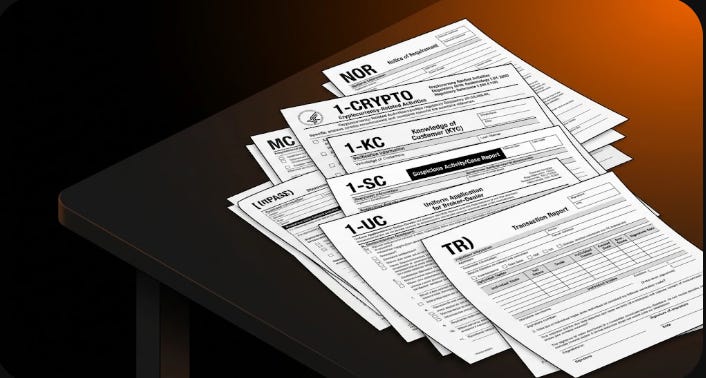
EDGAR filings across six new form types (Forms NOR, 1-CRYPTO, 1-KC, 1-SC, 1-UC, TR),
issuer websites,
whitepapers,
social media,
on-chain data, and
public communications.
All of this must remain consistent with each other and current with the Rule 103 principles-based narrative topics at all times. Manually monitoring that surface area across even a modest portfolio of issuers is operationally inefficient and error-prone at scale. A late annual report can break state-law preemption on secondary transactions. A discrepancy between a whitepaper and a public statement can trigger antifraud exposure. A safe harbor certification that does not hold up against on-chain evidence can unwind an asset’s non-security status entirely. These are not edge cases. They are the ordinary failure modes of a compliance workflow that depends on human review across too many channels to track reliably.
This is the gap Lockchain is built to close, and the opportunity it is built to unlock. Rather than treating Regulation Crypto Assets as a compliance burden to manage, Lockchain turns the proposed regulation’s ongoing disclosure, reporting, and safe harbor mechanisms into actionable, scalable intelligence for capital allocation, liquidity provision, venue integrity, and regulatory supervision.
For asset & fund managers, that means pre-allocation due diligence and post-investment surveillance that surfaces reporting lapses, safe harbor events, and material disclosure changes before they alter an asset’s regulatory status or valuation drivers without warning.
For market makers, it means continuous visibility into whether an asset remains subject to an investment contract or has detached under the safe harbor. That distinction feeds directly into quoting, inventory, and hedging decisions in real time.
For exchanges, it means listing and ongoing surveillance infrastructure that tracks Rule 103 disclosure currency, Form TR certifications, and issuer reporting status automatically, reducing manual review costs and strengthening risk controls without expanding headcount.
For regulators, it means the ability to surface patterns of late filings, inconsistent disclosures, questionable safe harbor certifications, and offering-limit breaches across multiple issuers simultaneously, improving enforcement efficiency without requiring constant manual review of every channel.
Because the rules are still proposed, Lockchain is also built to adapt. The 60-day comment window will produce changes. Subsequent guidance will fill gaps the proposal leaves open, and market practices around Form TR certifications will develop in ways no one can fully anticipate today. A compliance intelligence platform that locks in to the proposed rule text as written is already obsolete before the rules are finalized. Lockchain’s architecture accounts for that, scaling with the regulation as it matures rather than the version that exists today. The projects and market participants that move through this new framework fastest and most safely will be the ones who treated compliance as automated infrastructure from the start. If you are an issuer, fund manager, exchange, or market maker trying to get ahead of what this framework demands, reach out to us today.
mac@lockchain.io | brian@lockchain.io